

Text By Niklaus Ramseyer, Berne.
(Original article here in German)
Armed neutrality means consistently renouncing war as a primitive, backward instrument of foreign policy. It represents progress away from war and toward peace.
For 170 years, Switzerland has had no enemies—either in the region or worldwide, and certainly no military enemies. During that time, it has neither waged a war nor had to endure one. This stands in stark contrast to every other European state. We on the Swiss left must defend the peaceful character of our neutral country.
Switzerland without war! Why? Not because the country wants nothing to do with the military or supposedly understands nothing about it. For a long time, Switzerland was said not to “have” an army but to “be” an army. This was because of its militia system (a largely citizen-soldier army), which forgoes professional troops but requires every citizen deemed fit for service—and allows women to volunteer—to receive military training by the age of 20 at the latest. It was also because, after completing that training, soldiers took their personal infantry weapon, an assault rifle, home with them—the much-debated but unique “rifle in the cupboard.”
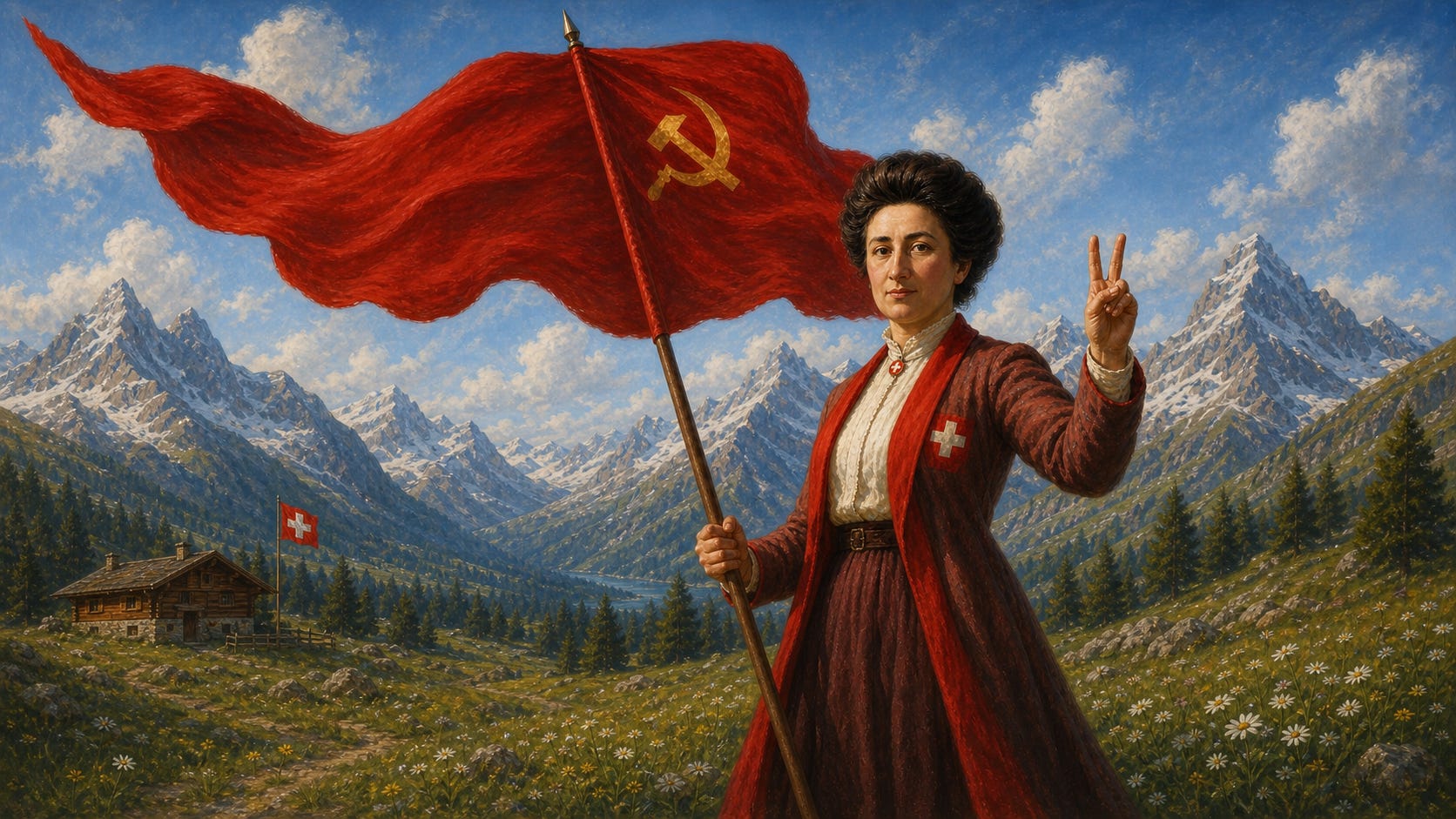
A militia army strictly limited to emergency defence, together with an armed citizenry and the rifle in the cupboard: this is exactly what the legendary socialist Rosa Luxemburg called for in a well-founded analysis of the “New Army,” published on 9 June 1911 in the Leipziger Volkszeitung, of which she was editor-in-chief. Even today, Switzerland’s military and defence policy corresponds quite closely to Luxemburg’s defensive, progressive, and peace-oriented ideas. A militia army, neutrality, and the renunciation of wars of intervention are therefore decidedly left-wing concepts.
Always a Country with an Army—Never a Country of War
Switzerland is certainly a country with an army and a military. But it has never been a country of war—least of all of intervention, aggression, and occupation beyond its borders. The reason is Swiss neutrality. As almost no other country in the world does, Switzerland consciously and consistently renounces war as a primitive and backward “instrument” of foreign policy. Unlike in nearly every other state, war in the Swiss Confederation is not an “instrument” in the government’s hands with which it could violently and destructively impose its foreign-policy or even global “interests” (see Clausewitz, On War, 1832).
Our country would go to war only if it were attacked militarily. In that event, every Swiss citizen fit for service would be called upon to contribute to the country’s defence within the militia system. The purely defensive—rather than offensive and invasive—nature of this security and defence concept is also evident in the structure of the Swiss armed forces: they are organized so as to be “structurally incapable of attack.” This is particularly apparent in logistics: a collection system without long-range transport aircraft, unlike the delivery systems used by NATO or US forces that wage wars around the world. It is also apparent in the preference for more defensive weapons systems.
The country does not need bombers such as the F-35 that can be deployed in invasions worldwide. After all, the Swiss Armed Forces’ main task is not to be able to wage wars somewhere against someone. It is to keep all wars away from our own country. Switzerland’s militia army is not a “war-fighting army” but a “war-prevention army.” For more than 170 years—since the brilliant Guillaume Henri Dufour—it has fulfilled this principal mission far more successfully than any other army in Europe.
The political foundation of this peaceful and highly successful security concept is neutrality. It should be understood in purely military and security-policy terms. Small Switzerland, at the heart of Europe, threatens no one and nothing—certainly not militarily. In return, it enjoys considerable esteem, respect, and trust around the world. Switzerland has few adversaries and no enemies—certainly no military ones.
Social Democrats and Free-Market Liberals Call for NATO Instead of Neutrality
Switzerland’s uniquely successful and progressive security policy is now being questioned and attacked—from both the right and the left. Demands for “greater cooperation” with NATO, which wages wars worldwide and remains dominated by and dependent on the United States, and for “security cooperation” with the EU come from the FDP.The Liberals (Switzerland’s free-market liberal party) and The Centre (a centrist Swiss political party). Unfortunately, they also come from parts of the Social Democratic Party and the Greens.
The right argues that, as part of an informal “West,” our country must also help conduct a “united” struggle—under US leadership—against Russia, Islamism, and China. The governing left, for its part, views Switzerland’s independently sovereign security policy and neutrality as obstacles to the country’s long-desired “integration” into the Brussels-based EU. Supposed “leftists” even call for our army to join NATO—or at least to move “closer” to it.
Both political camps promote the belief that Switzerland could not defend itself militarily on its own. Yet historical and current examples—from Vietnam and Afghanistan to Ukraine and Iran—show how successfully determined defenders can fight on their own strong terrain, even against attackers that appear vastly superior at first sight.
Nevertheless, politicians receive some support from officials and career military officers in the DDPS (Federal Department of Defence, Civil Protection and Sport) and at the top of the armed forces, both of which have suffered from weak political leadership for decades. They, too, disparage Switzerland’s defensive army and claim that alignment with NATO is therefore unavoidable—and that rearmament in accordance with Trump’s demands is urgently needed here as well.
Thus, a motley collection of “NATO adapters”—career military officers and DDPS officials under weak political leadership, alongside politicians of the left and centre—are fighting against our peaceful country’s military sovereignty and neutrality: fundamental Swiss principles that they should, on the contrary, be defending.
This is particularly embarrassing for the members of the Social Democratic Party of Switzerland (SP/SPS) in this alliance. Only a few years ago, their party programme still championed self-government, sovereignty, and a policy of peace. In fact, only two countries in Europe remain sovereign in military-policy terms today: France and Switzerland—for now. Neither tolerates foreign bases, and both retain full democratic control over all their own troops in the country.
Every other NATO country “hosts” US occupation troops on sealed-off bases within its territory, over which it has no control and often not even access. Several NATO governments in the EU even accept bases for US nuclear missiles. Contrary to the brazen claims of NATO ideologues, these US military positions, advanced thousands of kilometres eastward, are not “protective umbrellas.” On the contrary, they are grave sources of danger. In an emergency, they would be the first targets of preventive strikes, with hundreds of thousands of uninvolved people in the surrounding areas becoming “collateral” victims.
Wars of Aggression in NATO’s Wake Instead of Defence Only in an Emergency
With their attacks on Switzerland’s military sovereignty and neutrality, the Social Democrats, FDP.The Liberals, and The Centre do not seek to restore to the Federal Council (Switzerland’s seven-member federal government) the power to wage war claimed and exploited by the backward governments of militarized great powers. For a small country such as Switzerland, that would in any case be illusory, if not ridiculous.
No. Under the banner of “cooperation,” they intend gradually to professionalize the hitherto purely defensive Swiss militia army—through continuous-service conscripts (soldiers who complete their service in one uninterrupted period)—and coolly move it closer to NATO through exercises, planning, intelligence, and ammunition procurement beyond the country’s borders. Swiss soldiers are once again supposed to learn and practise aggression, invasion, and occupation in exercises abroad, instead of defending the country on its own strong terrain.
Everything would take place under NATO supreme command and, ultimately, as auxiliary forces for the US Army, which wages wars worldwide. Decisions about whom to mobilize against and whom to fire upon if necessary would no longer be made under the “primacy of politics” (civilian political control) in Bern, but by military planning staffs somewhere in Mons or Tampa Bay. Those staffs would naturally demand reciprocity in the form of NATO exercises here in our country. For our sovereign, neutral state, that is an absolute no-go.
There is no middle position between military sovereignty with neutrality, on the one hand, and subordination to NATO—called “cooperation”—on the other. The foreign base used by Switzerland’s SWISSCOY continuous-service personnel in Kosovo (the Swiss contingent supporting KFOR)—a.k.a. “mercenaries,” as the author puts it—is, in practice, the sandbox and training ground for integrating our armed forces into NATO. It is a typical follower-and-auxiliary deployment under the NATO command of KFOR (the NATO-led Kosovo Force). In Ferizaj, Kosovo, KFOR guards and secures Camp Bondsteel in particular, the largest US military base in Europe.
It is astonishing, even alarming, that supposed leftists in the Social Democratic Party of Switzerland continue to support military adventures of this kind. They carelessly surrender democratic control over defensive forces in our own country while accepting foreign NATO control over our troops during invasive missions elsewhere. They even do so under the more than cynical heading of “solidarity” with “peacekeeping forces.” For the modern “integrationist Social Democrats”—and even for the Greens—solidarity, it seems, now also “grows out of the barrel of a gun.”
In short—and it is not good: we are moving away from Switzerland’s sovereign, democratically controlled defensive army and toward semi-professional follower and participation forces under foreign command on NATO training grounds or even in NATO “war theatres” that are not ours and cannot be ours. And we are expected to pay for this dangerous nonsense as well.
US and EU Sanctions Have Nothing to Do with the Rule of Law
Unfortunately, the same conformism and eagerness to participate are even more evident in relation to US and EU sanctions. If these sanctions had even the slightest basis in the rule of law, they would have to rest on the following legal standard: “Regimes and governments that systematically disregard and violate human rights and international law shall be appropriately sanctioned and boycotted.” Properly applied under the rule of law, these rules would naturally have to apply equally to every usurper, perpetrator of genocide, and war criminal. Russia would certainly be sanctioned—but so, without question, would Israel, the United States, Turkey, and Saudi Arabia.
Yet nothing of the sort happens. Sanctions are arbitrarily imposed only on countries—and individuals—that refuse to dance to Washington’s tune, from Cuba and Iran to North Korea and Russia. And not only by the United States itself: by threatening sanctions, Washington also coerces many smaller states in its “values-based West,” even though those states have no problems, tensions, or conflicts with the countries targeted by US sanctions.
Switzerland, for example, is threatened by neither Cuba nor Iran nor North Korea. Yet under pressure from the United States and the EU, the Federal Council sanctions those countries so severely that it has become almost impossible to transfer aid funds to Cuba. Transfers to Taiwan, by contrast, remain possible at any time without difficulty.
Switzerland’s Untenably Submissive Embargo Act
The reason for our federal government’s timid and embarrassing conduct lies in Switzerland’s Embargo Act of March 2002.
Article 1 states:
“The Confederation may enact coercive measures in order to implement sanctions that have been ordered by the United Nations Organization, the Organization for Security and Co-operation in Europe or by Switzerland’s most significant trading partners, and which serve to secure compliance with international law, and in particular respect for human rights.”
There would probably be little objection to this wording. But the Embargo Act is not a Swiss law governed by clear rules that apply equally to everyone. It is a vague mechanism for joining in and enforcing measures on a case-by-case basis. Moreover, it starkly contradicts the separation of powers: sanctions may be imposed—or their imposition assisted—not by the courts but by the government, the Federal Council. Worse still, there is simply no right of appeal to a higher authority against its decisions, although such a right should be self-evident under the rule of law.
The phrase “or by Switzerland’s most significant trading partners” is also untenable and even dangerous. Instead of laying down clear rules that apply to everyone, it opens the door wide to those trading partners’ arbitrariness and pursuit of power—and to compelling neutral Switzerland to support their trade wars. On the basis of this absurd provision, Washington in particular can place the Federal Council under enormous pressure and demand that our country sanction states with which we have neither problems nor conflicts of any kind.
It is alarming that left-wing and Green members of the Federal Assembly (Switzerland’s parliament) supported and continue to defend such dangerous nonsense. The neutrality initiative (a Swiss federal popular initiative) now seeks to correct these serious defects in Switzerland’s Embargo Act by deleting the reference to “significant trading partners”—nothing more and nothing less.
But during the referendum campaign, the Social Democratic left—and the Greens as well—will once again stand on the wrong side: on the side of war within the NATO alliance rather than peace and Swiss neutrality, and on the side of arbitrary US sanctions in Washington’s trade wars rather than clear rules, applied equally to all, under the rule of law. That is certainly not left-wing politics.
Niklaus Ramseyer is a Swiss journalist. He served as Bundeshaus correspondent for the Basler Zeitung.
Excellent article, thank you for all the details! Your fight against joining NATO is very reasonable -- indeed, "[...] US military positions [...] are not 'protective umbrellas', [but] grave sources of danger."
But if I may, I would add some details for the sake of historical record.
Libya was also neutral (Muammar Gaddafi was the leader of the Non-Aligned Movement) and didn't threaten anybody. Why did then Libya get attacked by NATO in 2011, and Switzerland not?
Switzerland was allowed to be "neutral" because of her being part of the Western financial system -- Switzerland served as an OFFSHORE before the island offshores/tax havens (in my country, the phrase "to have a Swiss bank account" implies that the bank account owner is involved in shadowy, criminal business, or/and is a Western agent sponsored by his Western masters).
Besides that, during WWII Switzerland was not completely neutral. Switzerland provided Germany with arms, ammunition, and machinery, including locomotives as well as agricultural products. Allied bombing campaigns eventually forced Germany to move some of its arms factories to the safety of Swiss territory. Swiss territory was also used for all kinds of intelligence operations for all involved in WWII, but interestingly enough, the German SA and SS (secret police) were able to neutralize Soviet intel posts, but not the other way around. Also, it was Switzerland where Allen Dulles met with high-ranking SS officers in 1945, secretly negotiating their surrender to the USA, behind the back of the Soviet Union.
So, my conclusion would be that Switzerland was always a little wheel serving in the machinery of the Western financial empire (still maaged by the London City).
Until now, Switzerland served the empire as an offshore banker. Now, when the Western empire is trying to preserve its global domination by amounting all the accessible resources, Switzerland is asked to become a soldier and fight for the empire on the battlefield.
This is a fantastic piece. How tragic that a generation of the Left thinks it is 'progressive' to support NATO and its war-mongering. How could this have happened in societies like Sweden and Switzerland that are amongst the most educated and civilised on the planet?