

I was supposed to be in Malaysia for the Penang Peace Dialogue (Sept. 5-6). Unfortunately, I could not attend, but Dennis and Michael Riches took up the opportunity to participate on behalf of Neutrality Studies. Their report from Malaysia gives us an account of the arguments, encounters, and Southeast Asian realities that reveal where political thinking is moving.
Organised by the Commonwealth of World Chinatowns, the gathering included Kishore Mahbubani, Victor Gao, Joanna Lei, Jomo K. Sundaram, and even former Indonesian president Joko Widodo. Jeffrey Sachs joined remotely. These were people familiar with governments, universities, and international institutions, hence their criticism of Pax Americana came with considerable experience of how that order operates.
Dennis and Michael describe a surprising confidence among participants that Asia is acquiring the power to shape its own future. The interesting question is what they intend to do with it.
A Different Place to Have the Conversation
Dennis noticed something that might seem incidental but highlights that much of the Global South has retained critical analysis not only in the political but the economic sphere, too: Malaysian businesses sponsored a gathering where speakers openly condemned Israel’s destruction of Gaza, discussed China’s rise, and questioned Western claims to moral leadership.
Corporate sponsorship hardly guarantees political independence. Nevertheless, it tells us something about which opinions are considered respectable in a particular society. Arguments treated as disreputable in parts of the Western public sphere could be voiced here by prominent participants with little apparent embarrassment.
Michael’s broader observation was that the confidence extended beyond China. He heard intellectuals from South and Southeast Asia discussing their regions as actors with their own purposes and not as this or that great power’s “ally”. A multipolar world would offer little emancipation if smaller countries merely exchanged one relationship of dependence for another.
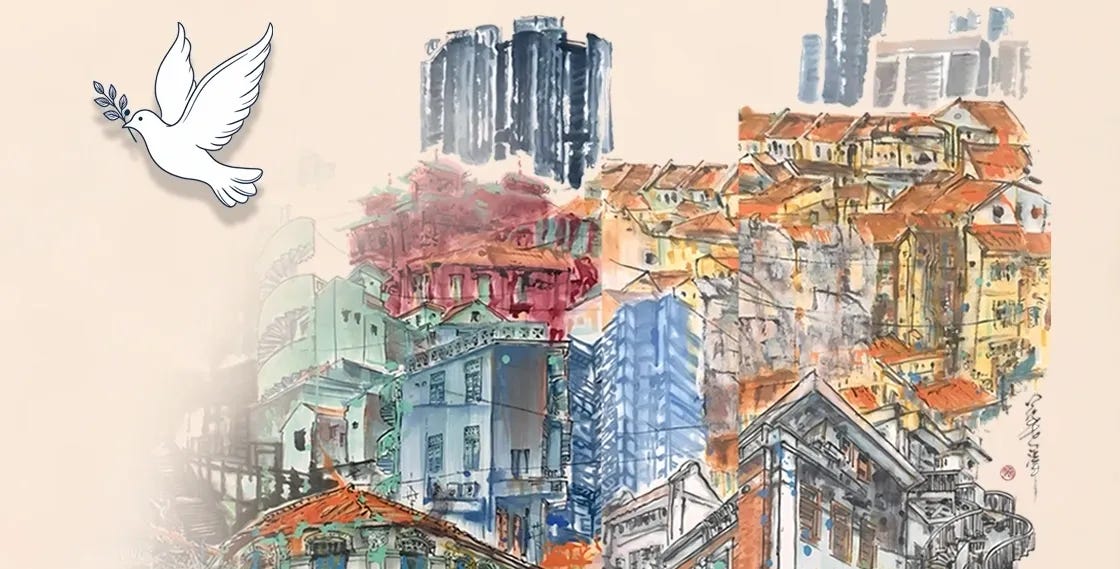
Penang itself supplied a fitting setting. Dennis described George Town’s galleries, street art, and restored buildings; both brothers welcomed the place given to artists and musical performances. The surrounding discussion of Chinese diaspora culture also complicated the idea that a civilisation belongs exclusively to one state. Communities preserve, adapt, and transmit traditions across borders. Political maps do not contain everything.
Gaza and the Limits of the United Nations
The most moving moment, Dennis recalled, came when a Palestinian student studying in Malaysia spoke about losing members of her family in Gaza. Her appearance brought the discussion of international order back to what that order is supposed to protect: people trying to live.
The Gaza Scholarship Initiative offered one concrete avenue for solidarity. Dennis also reported an organiser’s concern that international fundraising could encounter blocked financial transfers. Even assistance, it seems, must navigate the infrastructure through which political power operates.
Gaza sharpened the debate about the United Nations. What use is an institution whose most urgent decisions can be blocked by a permanent member of its Security Council?
Panelists defended the UN on the grounds that its disappearance would leave smaller states even more exposed. The veto was discussed as both a source of paralysis and part of the bargain keeping powerful states inside the institution.
There is an uncomfortable logic here. An organisation that includes the Great Powers must accommodate their power sufficiently to retain them. Yet those accommodations can prevent it from restraining them.
For countries seeking greater independence, reform therefore involves a difficult practical task: preserving a common forum while reducing the capacity of its strongest members to render it ineffective.
Bandung’s Unfinished History
A recurring proposal at the conference was “Bandung 2.0”: a renewed movement for cooperation and independence among formerly colonised societies. However, Dennis pointedly asked about what actually happened to Bandung 1.0 and what has been learned from it?
He raised the destruction of Indonesia’s earlier political direction and the mass violence associated with the upheaval of 1965. His recollection of the response was telling: assurances that the spirit of Bandung remained alive, with little engagement with the mechanisms through which its political possibilities had been crushed.
Dennis felt that the presence of Indonesia’s former president and accompanying Indonesian media encouraged caution. That is his interpretation, but the unanswered question remains important regardless of the reason.
A renewed movement needs to understand what could defeat it. Foreign intervention, domestic repression, and conflicts within the countries claiming solidarity cannot simply disappear beneath an anniversary slogan.
It might also be a good idea to add more voices from across Southeast Asia. A conference discussing regional emancipation needs room for the region’s disagreements. Otherwise, the people whose histories most disturb the comfortable narrative may once again find themselves outside it.
Taiwan and the Space for Imagination
Michael, who has lived in Taiwan for years, tested another boundary. With Victor Gao and Joanna Lei on the panel, he proposed a hypothetical “Commonwealth of China”: two politically distinct entities joined by agreements addressing Beijing’s security concerns.
His proposal went well beyond economic cooperation. It included a military alignment with China and arrangements involving maritime access. This was a thought experiment about whether security accommodation could coexist with preserving Taiwan’s political system.
As Michael recounts it, Gao rejected separate statehood and insisted on reunification under one government. The other panelists did not have time to respond.
We should neither mistake Michael’s hypothetical for an agreed solution nor treat Gao’s answer as a negotiated government position. The exchange nevertheless exposes a central difficulty: security, sovereignty, and political identity overlap without becoming interchangeable. Addressing one does not automatically settle the others.
Encouragingly, Michael says Gao approached him afterwards and invited continued contact. A disagreement on stage had left a channel open.
That may be Penang’s most useful lesson. Confidence in an emerging multipolarity is growing, but peaceful relations will depend on what happens when confident actors disagree. The same gathering that challenged Western dominance encountered uncomfortable limits in discussions of regional history and sovereignty.
Those limits deserve sustained attention. More centres of power will mean more centres capable of saying no. Building peace will require institutions, relationships, and political imagination strong enough to keep the conversation going after they do.
My special thanks to Dennis and Michael for attending and reporting form the conference! — Pascal.
Thanks, Pascal. Here's an additional link to the speech by the student from Gaza (7 minutes). She gave me permission to share it with a larger audience. https://vimeo.com/1226356760
The UN is beyond reform. It needs to be replaced by a truly independent institution that has the power to enforce international law. Headquartered outside the US, its first priority should be to protect its officials from intimidation and coercion.