
On Russophobia
Reflections on the European racism at the heart of the continent's war obsession with Russia.

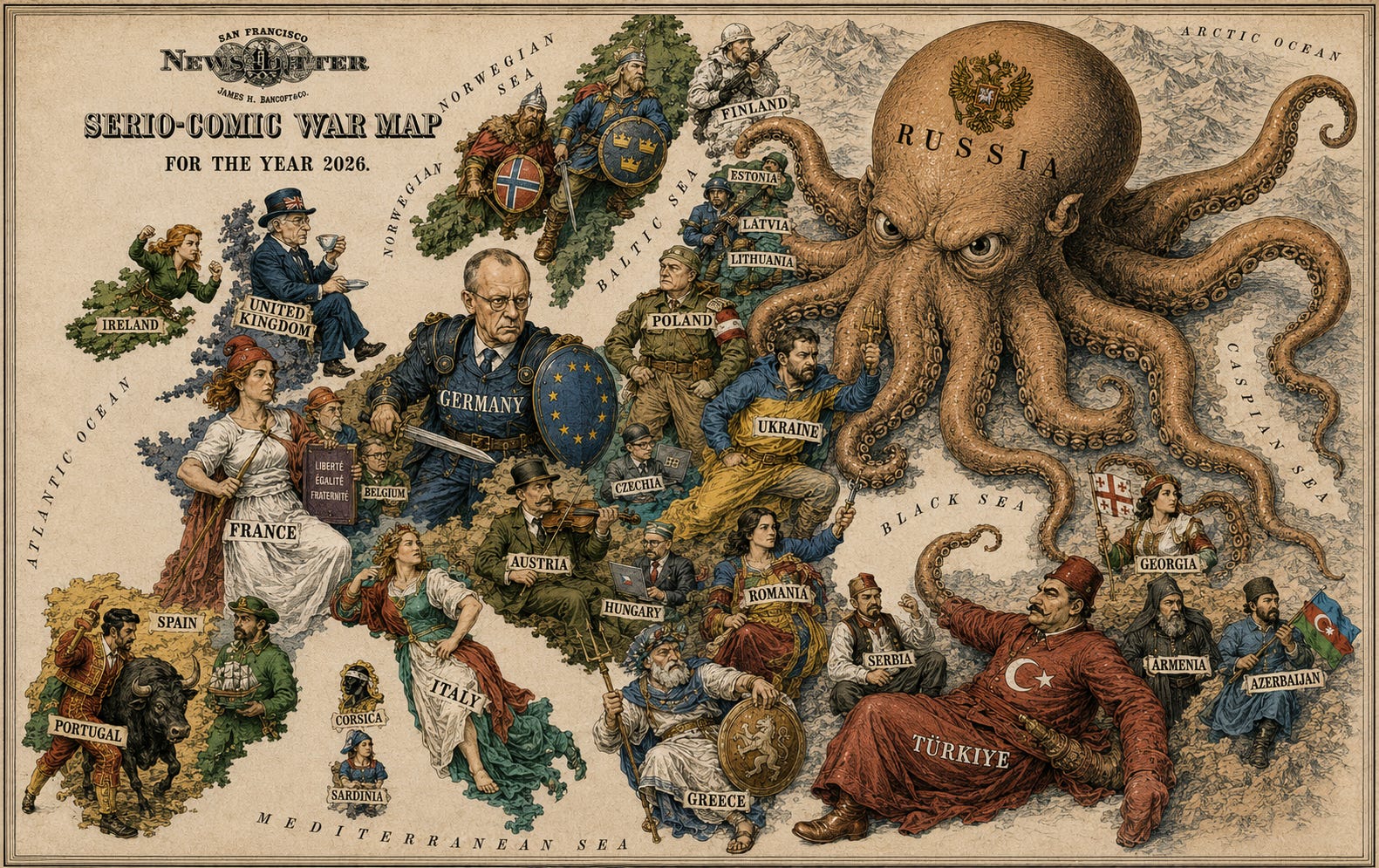
Last week I attended a conference on Russophobia, as described here. The following are my reflections on a topic I was only vaguely familiar with through the writings of Glenn Diesen and Guy Mettan, but which I had never investigated properly myself.
Dialectical Racism
The most important insight I took away from the week-long discussion in Pskov was that Russophobia is first and foremost a political phenomenon, a form of racism, intentionally fostered, and remarkably similar to antisemitism (as Yakov Rabkin pointed out). It creates a hollow but dialectical stereotype of a group that needs to be othered.
In the case of Russophobia, the imagined character of “the Russian” is on the one hand weak and ridiculous: lazy, drunk, stinking, stupid, and complicit in his (and often also her) own enslavement by the despotic state, which the Russians are too dumb to rise against. We could call this part of the racist stereotype “imbecile Russia”.
On the other hand, the same stereotype describes Russians also as threatening, brutal, treacherous, animal-like (bears), and of an intense immorality. Let’s call this one “savage Russia”. Alexander Mercouris, at the mentioned conference, did a marvelous job of listing Western novels, plays, and films over the last 250 years in which this caricature is being portrayed again and again.
On the political level, the imbecile and the savage function as the two sides of a straw-man argument for Western societies to latch on to. The imbecile savage is easy to ridicule and hate at the same time. The laughter at the stupidity of Russia eradicates fear about it, and the hate of its insane brutality and treachery creates the will—sometimes even the psychological need—to seek its total destruction. It’s what motivates comments like those by Kaja Kallas about breaking up Russia into smaller nations to make it finally go away—like the spider or cockroach in your bedroom that you need to know is gone or dead before you can finally catch some sleep.
War Racism
Looking back at the last four years of war, the imbecile savage provided a constant narrative undertone in what Richard Sakwa calls the Political West. Especially Europe’s drive toward remilitarization would not be possible without it.
The believed ridiculousness and weakness are at the heart of claims about Russia being so poor and dumb that their army had to fight with shovels or use dishwasher chips to power its tanks. At the same time, we are told countless times the same Russians are so brutal and unpredictable that out of their evil nature, they might attack Europe and slaughter their way through to Portugal if not stopped in Ukraine.
Hence, on the one hand, the imbecile savage is a threat to all of humanity because it is brutal and despotic. Yet, on the other hand, it is also dumb and unworthy. What follows implicitly—and logically—is that only force can stop the savage. But, luckily, it’s going to be an easy task, since the savage is also stupid. So fear not, Europe, for all you need to do is to arm yourself, and you shall prevail. The imbecile savage is dangerous but defeatable. Therefore, fight we must.
Once you sharpen your eyes for the imbecile savage, you’ll find it at the heart of so many of the West’s war narratives. It’s quite fascinating.
Reconciling Stupidity
While depressing, this insight at least gives me some intellectual closure as it makes it a little bit easier to understand why so many people would believe the self-contradicting stories we are told in mass media about the Ukraine Proxy War. The propaganda about the underlying nature of the imbecile savage is so much older than the war and so deeply learned that whoever is not aware will fall right into the trap. Westerners simply connect current affairs with the racist stereotype—et voilà, you’ve got yourself a functioning and deeply rooted narrative about “the other” that can and will be repeated in society ad nauseam since it confirms what is believed to be well known anyhow.
That also finally gives me a clue as to why in the Global South the ratcheting up of war fever against Russia did not work. While India, China, and many others opposed and criticized Russia for the invasion of Ukraine back in 2022, they refrained from going into an anti-Russian frenzy. Rather, they looked at the situation objectively, trying to understand Russia’s motivations—something you can only do if you are not poisoned with a hollow stereotype about it. Many in the Global South also seem to intuitively understand the racist nature of the West’s portrayal of Russia since they themselves have been on the receiving end of such colonial European mechanisms.
Even my dear Japan did not join the militarism against Russia the way Europe did. While Tokyo is rearming, that is mostly done in the name of defending against China and North Korea (another unconfronted ghost of the past and a discussion for next time). Japan never sent weapons to Ukraine, let alone coordinated attacks on the Russian mainland as the NATO war alliance is now doing. While there is some fear in Tokyo about the future of Russian-Japanese relations, I can say with certainty there is very little Western-style Russophobia. Academic institutions still hire Russian researchers, orchestras can still play, and Russian culture is still appreciated. Political animosity is directed toward the Russian government but more out of a geopolitical necessity—being part of the US hub-and-spokes system, not out of hate.
Unconfronted
Overall, I think Alexander Mercouris’ analysis is the most pertinent: Russophobia “works” because the racist nature of this stereotype has never been confronted by the Euro-American conquistadores who did similar things to other peoples. In the West (the Americas) as well as in Australia and New Zealand, they managed to genocide their way into the lands they colonized. In the East and the South, they also went on insane rampages (Congo, Algeria, Palestine, Vietnam, to name just a few) but they ultimately hit roadblocks that stopped them. Some of the underlying racisms were confronted out of necessity—against blacks, against Jews, against Asians—but others remained very much intact. Russophobia is one of them.
Until and unless the Euro-Americans start doing some deep introspective work as a “value community”—as they like to call themselves—we won’t get over this, and the imbecile savage will inspire the worst in people who have proven over centuries what kind of savagery they themselves are capable of.
God, have mercy and send us some introspection. Please.
We really need it now.
Add to this list the 'little Russians', the Serbs, that the West has decided are also on the shit list. So it is legit to take their lands in Kosovo and create a military colony for NATO bases, for Croatia to join the EU without accepting the 250K Serb refugees it ethnically cleansed back into its lands, and on and on..
The Hapsburgs had a saying in WWI, " Serbien muss sterbien" - Serbs must die’.. i.e. be killed/slaughtered. They didn't hide the racism. Just like modern day Israelis openly express their hatred of all things Palestinian, they felt that their hatred of all things Serb was not only justified but morally correct.
Fuck these people is what I say.
If I were the ruler of Russia, not only would I have already taken out that fucking little zionazi Smellensky, but I also would have taken out that pedo Macron, the zio-asswipe Starmer and that aristocunt Wonder Lying..
But that is precisely what I am not the ruler of Russia or any other nation.. I am a hot head who would cut off heads first and then think about the consequences..
Excellent essay. What you are eluding to towards the end of the essay by saying that Europe needs to do some deep introspective work I agree with, and I think that one of the things they need to work with is what some call 'Post-Colonial Anxiety' (paralysis caused by unprocessed historical guilt).
I have - partially unsuccessful I must add - been trying to understand Europea apparent moral deficit and I think it may stem from three interlocking drivers: Technocratic Substitution (replacing ethical judgment with administrative procedure), Post-Colonial Anxiety (paralysis caused by unprocessed historical guilt), and Fragmented Identity (the inability to form a cohesive "We").
Technocratic Substitution: Ethics as Administration
The first driver of the European deficit is the Technocratic Substitution. In the US, the "Servile Education" produces consumers. In Europe, it produces administrators. The European project has attempted to solve moral problems through regulation, directives, and committees. This creates a dangerous illusion: that if we have a rulebook, we have morality.
The Illusion of Neutrality: European technocrats often believe that by removing "passion" and "ideology" from governance, they achieve objectivity. But the concept of the Village Worthies (the "Thieves of Virtue") serves as a profound warning: virtue cannot be proceduralized. When a moral dilemma arises (e.g., migration, war, economic inequality), the European response is often to form a committee, draft a report, and issue a statement.
Post-Colonial Moral Anxiety: The Paralysis of Guilt
The second driver is Post-Colonial Moral Anxiety. Unlike the United States, which often operates under a myth of "innocent exceptionalism," Europe carries the heavy, unprocessed baggage of its imperial history.
The Refusal to Name Power: European elites are often terrified of being accused of "neo-colonialism." Consequently, they refuse to name power dynamics clearly. When European nations intervene in Africa or the Middle East, the discourse is rarely about "interest" or "strategy"; it is framed as "development," "stability," or "humanitarian aid." This linguistic evasion prevents the "Test of Universalizability." If you cannot admit that your actions serve your own interests, you cannot hold yourself to a higher standard. You are trapped in a defensive posture where every action must be justified as altruistic, making genuine self-scrutiny impossible.
The Export of Guilt: This anxiety leads to a peculiar form of moral displacement. Europe often directs its moral concern outward—toward distant conflicts, refugee crises, or climate change—while neglecting the erosion of solidarity within its own borders. The "Higher Standard" requires looking inward first. But for Europe, looking inward feels like reopening old wounds of guilt. So, the gaze is turned outward, creating a "performative morality" that looks impressive in Brussels but fails to address the rotting social fabric of cities like Marseille, Athens, or Berlin.
The "Savior" Trap: This anxiety fuels the Positive Golden Rule. Because Europe fears being seen as "bad" (colonialist), it over-compensates by trying to "save" everyone. This creates a Paternalistic Overreach where the EU imposes its values on others, not because it respects them, but because it is desperate to absolve its own historical guilt.
Fragmented Collectivism: The Weak "We"
The third driver is Fragmented Collectivism. Europe is not a single nation; it is a collection of nations with deep, often conflicting histories. The "European Identity" is thin, a legal construct rather than a cultural reality.
The North-South Divide: The moral solidarity between Germany and Greece is fragile, fractured by economic resentment.
The East-West Divide: The moral consensus between Poland and France is strained by differing views on sovereignty, rule of law, and history.
The Result: There is no single "European" circle of moral concern. When a crisis hits, the "We" fractures into "Us vs. Them." This fragmentation makes the "Higher Standard" impossible to apply collectively. A German leader cannot easily hold Germany to a higher standard if the Polish leader is accusing them of imperialism, and vice versa.
The Consequence: This fragmentation forces the EU to rely on Technocratic Substitution to hold itself together. Since there is no shared "We," the only glue left is the "Rulebook." The bureaucracy becomes the substitute for community.