

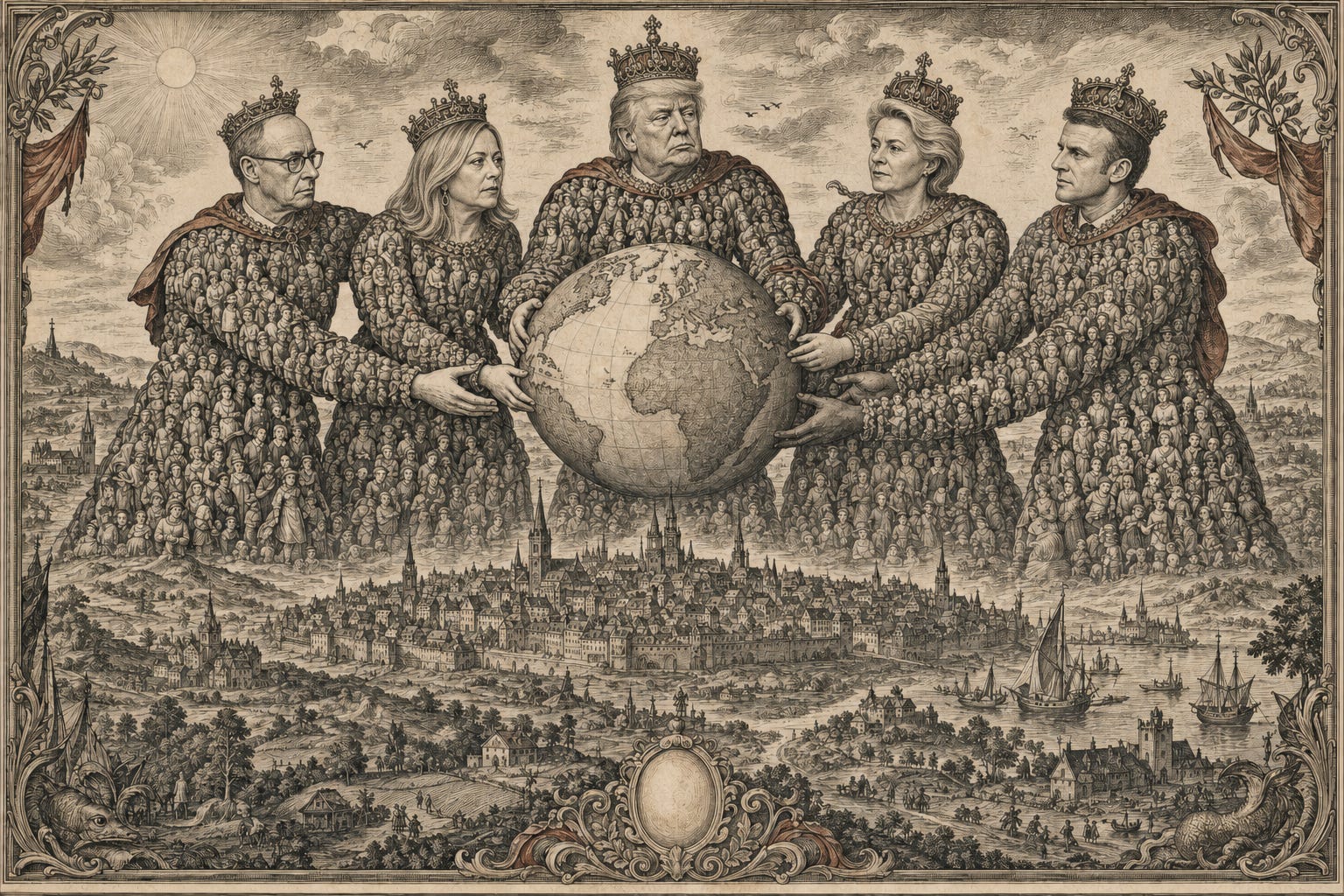
Crisis of the West, Crisis of Realism
How do we explain the self-defeating and self-harming policies of Western states?
Europe seems to be happily deindustrializing, the US proxy war in Ukraine is killing hundreds of thousands (if not millions) of Ukrainians—the very people NATO swears it wants to protect—and by now this warfare is close to swapping over into the continent. And what does Europe do? Doubling down on the policies that have been failing them for twelve years—creating a 21st sanctions package (!). No diplomacy in sight. At the same time, the war the US/Israeli alliance started against Iran is laying waste to both their military installations and eating away on US hegemony in West Asia. Yet, the entire Euro-Atlantic leadership seems dead-set on continuing a course that many of us in the critical commentariat see as obviously ruinous and suicidal to most of the club members.
Of course, each theater, each war, each battle has its own narrative rationale on both sides. However, from a bird’s-eye perspective one is really left to wonder: what is riding the people who are taking these decisions? Just one example: The largest case of industrial sabotage in post-Second World War history—the attack on the Nord Stream Pipeline—is still unsolved, four years after it happened. We know by now that this is by design, as it would expose the inside nature of the crime. At best it was rogue elements in Ukraine (as the Germans are vaguely trying to establish), at worst it was a NATO job (as Seymour Hersh has been asserting). But there’s more. Why would Sweden and Finland give up the very security policies that kept them safe for decades and centuries? Why would no one in the West look at a compromise arrangement like a neutral Ukraine to avoid (or end) the war? Why would the USA want to fight another war with Iran rather than going back to the JCPOA that for all intents and purposes had achieved everything the Never-an-Iranian-Bomb crowd in the US and Israel had wanted? The list of self-defeating and self-harming policies goes on and on and on.
It seems to me that this is not just a crisis of the West, but a crisis for (scholastic) Realism, too. After all, one of the core-assumptions of Realism is that the actions of states are guided by national interest. This is especially true for great powers. While Realism does not claim that bigger states can’t infiltrate and abuse smaller countries through coercion and bribes, this should not be possible the other way around or lead to a circular logic in which suddenly the tail starts wagging the dog.
Yes, we could, at this point, venture either into micro-discussions about the political development of each case, the decision makers, the path dependence of the political trajectory at each point, etc. Or we can have a discussion about Grand Strategy, Brzezinski’s view of the Eurasian continent, divide-and-conquer, even about Marxism’s view of the primacy of economic structure underlying imperialism, or all the other overarching goals of empire that analysts like Brian Berletic point out time and again. We could equally go into psychological factors, mass-formation, elite capture, narrative control, or propaganda studies. Those are all important and pertinent aspects of what is going on.
But I’d rather reflect on a theoretical issue that irks me. The quiet assumption many in our profession seem to share that the highest level of actors in international relations is the nation state. May I ask: what if there is an even higher level, that sits above the nation state and functions as a (partially) structuring force behind mass behavior?
Realism tends to imagine the international world as a field of separate states. They are treated as units, like billiard balls, interacting with one another in an anarchic international system: they cooperate, compete, form alliances, go to war, and pursue interests. Most importantly, despite obvious power differences, they are all ultimately equal in the sense that the state remains the highest level of analysis. (Neo)Classical Realism explicitly disregards what happens inside “the black box” of the state, treating domestic factors as (largely) irrelevant to the movement of states, which it views in terms of power differentials and security competition. But it also turns a blind eye to meta-structures beyond that of the power distribution in the anarchic system. Issues like “norms” or “values” fall squarely outside the Realist framework—they leave that to the Constructivists to work on.
But the realist discussion also leaves out reflections on the quality and origins of interaction between states, especially the different degrees of integration they can experience. Some states are not just allied with each other. They are integrated so deeply that they behave less like separate bodies and more like parts of a team, even at the expense of what Realism would describe as their core-interests.
To make sense of it, and especially to reframe the behavior of Western nations, I want to propose the concept of the One West as a way of approaching the civilizational dimension of Western behavior in the international arena.
One West
What I mean by the One West is not identical to Richard Sakwa’s “Political West,” nor to what is often labeled in Russia and elsewhere the “Collective West.” It is related to both, but points to something slightly different. Sakwa’s political West, developed among other writings in Russia Against the Rest, describes an institutional and ideational bloc, the Euro-Atlantic order, built around NATO and the EU, that presents itself as the universal endpoint of history. Sakwa’s argument is squarely geopolitical, concerned with the West’s claim to embody a universal order.[1] So is the term “Collective West,” which many in the international blogosphere use to describe an oppositional structure of Western institutions confronting a multipolar order. Both terms, in other words, name a policy bloc. Through the One West I want instead to denote a civilizational body politic distributed across several states, nations, societies, institutions, and time. Not a single country, empire, or formal federation, but a historically evolved formation composed of different political organs that function together, coordinate with each other, and reproduce a common civilizational project across generations. An organism-like entity.
This may sound unusual, but hear me out.
IR has generally steered clear of biological metaphors for good reasons—they have a pretty dark history attached. Herbert Spencer’s nineteenth-century sociology treated society itself as a growing organism, differentiating into specialized parts the way an embryo differentiates into organs, though Spencer was careful to insist that the analogy showed only a parallel between social and biological growth, not a literal identity between the two.[2] His caution did not survive for long. Friedrich Ratzel’s organic theory of the state, and Rudolf Kjellén’s explicit description of the state as a “Lebensform,” a living form uniting territory and people, treated the state’s growth and expansion as literally biological, a matter of survival and “Lebensraum” rather than metaphor.[3] That literalism was later absorbed, in distorted and far more dangerous form, into Nazi Geopolitik under Karl Haushofer. This is why the discipline has treated biological language about states and civilizations as radioactive ever since.[4]
I want to be very clear that I am not reviving that lineage. A careful biological metaphor need not imply biological determinism. I am not arguing that civilizations are literally organisms, nor that political behavior is genetically fixed. I am proposing, instead, that some political formations may be better understood through concepts such as bodies, organs, membranes, nervous systems, metabolism, immune reactions, and reproduction than through the language of sovereign units alone. The metaphor, in other words, belongs to the same family as Talcott Parsons’s account of society as a system of interdependent subsystems performing distinct functions for the whole, or Niklas Luhmann’s use of the biological concept of autopoiesis, self-reproduction, to describe how modern societal subsystems maintain their own boundaries against a complex environment.[5] Both borrow biological vocabulary as an analytical tool, and it is in that company (not Ratzel’s or Spengler’s) that I mean to place the argument that follows.
The “body politic” itself, in fact, is a far older figure than any of this: John of Salisbury described the medieval commonwealth as a body with the prince as its head and the peasantry as its feet, and Ernst Kantorowicz traced how the same figure let medieval and early modern Europeans distinguish the king’s mortal body from the immortal body of the realm he embodied.[6] Naturally, also Thomas Hobbes’ Leviathan comes to mind, albeit that was formulated (and drawn) in a different national political context.
What I am proposing is a variant of this old habit of thought, redirected to capture the idea of an entire civilization rather than a single kingdom. The One West, then, is a way to name the collaborative behavior of some fifty-odd states, mainly the European colonizer states and their offspring, over the last five or six hundred years.
The State: Not Its Own Unit
If we begin from the assumption that nation-states are inherently separate, it is natural to ask about the influence of one unit on another, since we clearly observe different kinds of mutual interaction. And so, when one unit appears to exert influence over another, we are tempted to ask who controls whom. In its crudest version, the question becomes, for instance: does the United States control Israel, or does Israel control the United States? Does Washington lead Europe, or does Europe voluntarily follow Washington? Are NATO states sovereign actors, or are they subordinate to an American empire?
These questions are not meaningless, but something tells me they are poorly framed. If one looks at the many ways these entities interact, not only through treaty arrangements but through the social integration of trade, free movement of people, and especially intermingling of elites, one finds an entire epistemic community building voluntary policy coordination through “shared value” discourse and belief systems in which Russia is a “threat,” China is a “challenger,” Israel is a “victim,” and so on. Nel Bonilla has worked much on this issue (on my channel here, here and here).
So, what if we stop thinking about some of these actors as external to one another in the way the nation-state-centric model assumes? Maybe the integration runs so deep that the more appropriate way to look at it is through something else, like anatomy.
In that case, the US-Israel question resembles asking whether the heart runs the brain or the brain runs the heart. They are different organs but both necessary to keep the whole going. They have different functions, different capacities, and different kinds of influence. They may even come into tension. But they remain part of the same systemic formation, keeping each other afloat. This is a different claim from Alexander Wendt’s well-known argument that states can be treated as unitary “persons” with interests and identities constituted through social interaction.[7] Wendt personifies the state as a single actor facing other actors; the point here is closer to the opposite: to de-personify a set of actors that IR insists on treating as separate, and to ask whether some of them are better modeled as parts of one organism than as persons in dialogue with one another.
The One West as a Body Politic
In this sense, I propose that the One West be understood as a distributed, civilizational body politic. Its components include states, militaries, intelligence agencies, media systems, financial institutions, universities, legal regimes, think tanks, corporations, NGOs, philanthropic networks, ideological traditions, and religious institutions. These components are, of course, not centrally commanded. The One West does not require a world government or a hidden master plan. Its unity is “organic” in the sense that it is a sociologically explicable form of interaction and integration, naturally grown over a long period.
An organism does not function because every cell receives direct orders from the brain. Much of its behavior emerges from internalized patterns, feedback loops, homeostasis, environmental adaptation, and, of course, a shared genetic code. Something similar may be true of deeply integrated civilizational formations. They do not need constant explicit coordination to move in broadly similar directions. Their parts have been socialized into the same historical, non-teleological project. They share assumptions, moral hierarchies, threat perceptions, institutional habits, and narratives of legitimacy that function as coordinating mechanisms.
This helps explain why certain states and societies repeatedly converge on the same strategic projects, even amid disagreement among them. The One West has gone through internal wars, rivalries, and crises. Britain fought Germany. France clashed with Britain. The United States displaced older European empires. Yet these conflicts did not erase the deeper civilizational continuity of Western expansionism, colonial domination, racial hierarchy, capitalist integration, and geopolitical ordering.
The body fought with itself, but it remained a body.
Organs, Functions, and Distributed Power
A biological understanding also lets us think differently about power. In classic realist analysis, power is often imagined vertically: one actor commands, another obeys. But in a body, power is distributed functionally. Different organs do different things. Some circulate resources. Some produce cognition. Some provide coercive force. Some filter toxins. Some reproduce identity. Some identify threats. Parsons refers to this as the functional requirements of any social system, adaptation, goal attainment, integration, and pattern maintenance, each handled by a different subsystem so that the whole survives.[8]
In the One West, the United States may function as the central military and strategic organ. Britain often functions as a diplomatic, intelligence, and narrative (propaganda) organ. The European Union may function as a regulatory and economic organ. NATO functions as a military nervous system, in something close to the sense Karl Deutsch gave that phrase: a network for gathering, transmitting, and acting on information under conditions of stress—an integrated system of communication and control.[9] Israel functions as a frontier organ, a testing ground, and a condensed expression of settler-colonial logic in West Asia. Major media institutions function as sensory and narrative systems. Universities and think tanks function as cognitive and legitimating organs. Financial institutions provide, of course, money circulation. Legal institutions define what the body recognizes as order, rules, and legitimacy.
This does not mean the organs always agree. They can compete for resources, malfunction, or send contradictory signals; they can even damage the body they belong to. But they remain connected by a deeper structure of interdependence, which is why the search for a single controlling center so often fails. The One West does not usually operate through conspiracy or command. It operates through integration, with its power lying in the fact that its organs often act in concert without needing to be told to do so.
I have argued something structurally similar before, in a systems-theoretical register rather than a biological one: with Andreas Nishikawa-Pacher, we have described how permanent neutrality helps the diplomatic system remain stable against a complex environment, an achievement, we wrote, “that only an autonomous system can attain, only a system that produces internal mechanisms that hold its internal state relatively constant.”[10] The One West is the mirror image of that argument: a case in which a cluster of actors has produced internal mechanisms that hold their collective behavior constant through mutual integration.
The Membrane: Who Belongs and Who Does Not
An essential element of this metaphor concerns what belongs to the civilizational body politic, what does not, and why. We can call this the question about the body’s membrane. Every organism must distinguish between self and non-self. It must know what belongs to the body and what appears foreign, dangerous, or contaminating. The One West, we can assume, has such a membrane too. Luhmann’s systems theory rests on this distinction as well. He argues that a self-reproducing system does so through selective communicative operations, continually differentiating itself from its environment, deciding what counts as internal communication and what is external.[11]
This membrane is probably neither fixed in time nor clearly locatable in a geographical sense. Japan, for example, is not historically part of the Western civilizational core, yet it has been partially incorporated into the Western security architecture. Eastern Europe has been progressively absorbed into the Western body through NATO and EU expansion. Israel is geographically located in West Asia but functions as an intimate organ of the One West. Meanwhile, Russia, China, Iran, and much of the Arab and Islamic world are repeatedly constructed as significant others.
Hence, it seems, the membrane distinguishes along political, ideological, and strategic lines. It defines who can be integrated, who can be disciplined, who can be tolerated, and who must be confronted, externally and internally. Consider the recent sanctions against individual members of the One West: the EU has placed the Swiss military analyst Jacques Baud, the Swiss-Cameroonian activist Nathalie Yamb, and the German journalist Hüseyin Doğru under asset freezes and travel bans, formally under its sanctions regime against Russian “hybrid threats” and information manipulation, even though at least one of the three, Doğru, had built his public profile mainly on reporting about Gaza rather than Russia.[12] Whatever one makes of the underlying evidence, which several of the sanctioned parties and outside legal scholars have publicly disputed, the mechanism itself is a serviceable illustration of an immune system at work: a body disciplining its own cells for behavior it classifies not as illegal (what they did is explicitly allowed under the rules the One West gives itself) but as contamination from the outside, using the same institutional and legal apparatus that it also directs, in different registers, against fully external actors (sanctions are foreign policy tools).[13]
On the international level, this helps explain why some states can commit extraordinary violence and still remain inside the moral body of the West, while others are treated as permanent threats even when their conduct is less destructive. Consider the disparity in scale between the Gaza war and the war in Ukraine. By the most careful comparative estimate available, Brown University’s Costs of War project found (very, very conservatively) that civilians accounted for roughly eighty percent of fatalities in Gaza, against a civilian share in the low single digits for the Russia-Ukraine war, which has remained comparatively a war between armed forces.[14] Figures on both sides are contested and revised constantly, and should be treated with the caution any wartime casualty count deserves. But even allowing for that uncertainty, the scale of civilian death in Gaza is not in serious dispute, and it has not produced anything like the sanctions regime, diplomatic isolation, or asset seizures that Russia’s invasion produced within weeks. The One West recognizes Israel’s violence as necessary; it recognizes Russia’s as unacceptable.
The distinction, then, is not primarily about universal rules but about membership. Those inside the body are interpreted through the language of security, tragedy, democracy, complexity, or necessity. Those outside it are interpreted through the language of aggression, barbarism, terrorism, authoritarianism, or irrationality. Hence, many of us in the online commentariat criticize the West for its “hypocrisy.” That, however, is built into the system. It’s part and parcel of how the One West as a civilizational body politic deals with self and non-self. Hypocrisy is the membrane at work.
The One West and Its Significant Others
The One West defines itself through significant others. Russia, China, Iran, and the Arab world are geopolitical competitors partly because they are treated as civilizational outsiders. They may trade with the One West, negotiate with it, study in its universities, or adopt some of its institutions. They themselves, on an individual level, might even be perfectly integrated into the One West. Just think about the recent high-level meetingbetween the Acting US Secretary of the Navy, Hung Cao, a US official with (South) Vietnamese roots, and Vietnam’s President, To Lam. There is nothing that stands in between individuals becoming part of the fabric of the One West.
But on a political level, significant others are not recognized as part of the same civilizational body politic. This is what shapes the limits of empathy and integration. The One West can disagree with France, Germany, Britain, Israel, or the United States without casting them outside the body. Even something as dramatic as a World War only leads to a reconfiguration inside the body politic of who does what for the system. Not a civilizational break. On the contrary, it was the allies of WWII that ended up becoming rivals of the Cold War, while the erstwhile enemies in Europe and Asia were reintegrated into the Western project.
Conflicts with Russia, China, Iran, or Palestinian resistance movements are treated differently, framed as encounters with the outside: with the barbarian, the authoritarian, the terrorist, the Asiatic, the irrational, or the threatening.
This does not mean the One West is incapable of tactical cooperation with outsiders. Organisms interact constantly with their environment. They consume, exchange, adapt, and negotiate. But interaction is not incorporation. The key question is whether an actor is recognized as part of the body or as part of the environment against which the body defines itself.
The Colonial Project
How I see it at the moment, the One West is the product of a five- to six-hundred-year historical process, rooted in Western European expansion, Atlantic colonialism, settler colonialism, slavery, imperial competition, capitalist world-making, and the gradual construction of a global hierarchy centered on Europe and its offshoots.
The westward expansion of the Anglo-European world into North America, across the continent to the Pacific, and onward to Hawaii formed part of that civilizational movement. The same can be said of Spanish, British, French, Dutch, Portuguese, and later American imperial projects. These powers often competed with each other, sometimes bitterly. Yet their competition took place within the same overall framework: the outward expansion of the Western world and the subordination, absorption, or destruction of those outside it.
A wonderful example of the shared cooperative DNA within the competitive manifestation of colonialism is the many ways in which inter-colonizer cooperation still took place, even while they were vowing for power in their spheres. Take the innovation of “consular jurisdiction,” for instance, which was usually granted to all trading companies and foreign nationals of (western) colonizing states, not just the primary colonizer. This was particularly important for the Swiss. They didn’t have their own colonies, but their trading houses operated all over the globe: wherever a primary colonizer was present, the Swiss would go and do second-hand colonialism, piggy-backing on the European state that called the shots in the foreign lands and would administer consular jurisdiction.
Hence, I would argue, European empires fought each other over colonies, but the colonial logic itself was shared. The One West can accommodate both internal rivalry and external unity. This is also why the United States could displace Spain in Cuba and the Philippines and later inherited or transformed European imperial practices elsewhere with relatively little change for the colonized on the ground. Also France’s colonial war in Vietnam was followed by America’s war in Vietnam that was just as brutal and very much the continuation of the same underlying process. Although the details differ, both cases were part of the movement of the Western body into the non-Western world.
The One West is therefore not reducible to NATO, transatlanticism, or the American empire. These are merely contemporary manifestations of a much older body.
Gaza, Russia, and China
Let’s look now at current circumstances. The Gaza war, the confrontation with Russia, and the drive toward confrontation with China are often analyzed as separate crises. But they can—and probably should—be read as expressions of the same body politic defending, expanding, and reproducing itself.
As already alluded above, in Gaza, the One West’s moral membrane becomes visible. Israel is not treated as an external actor violating the norms of the West; it is treated as part of the West’s own body, so its violence is explained, contextualized, or shielded. Palestinians, by contrast, are positioned outside the moral body. Their suffering may be acknowledged sentimentally, but their political agency is pathologized and not only discarded but framed as the problem—terrorism.
In the confrontation with Russia, the membrane operates differently. Russia is European in geography and Christian in much of its history, and deeply entangled with European politics, yet it is repeatedly constructed as non-Western, Asiatic, despotic, and civilizationally alien, largely through politically manufactured Russophobia, which I wrote about earlier. Its exclusion is necessary for the One West’s self-definition, not out of racial or geographic necessity but due to the path-dependent nature of the One West’s self-understanding. Having othered Russia for at least 250 years, the distinction has become essential and engrained, hence even when Russia wanted to westernize and even join NATO it was rebuffed and never integrated like other parts of Eastern Europe.
China occupies yet another position: the great civilizational and economic other whose rise threatens the global hierarchy produced by centuries of Western expansion. The drive toward conflict with China is about the body’s reaction to a rival center of world-ordering power.
In all three cases, the One West behaves like an integrated system reacting to perceived threats. This explains why alliances among Western states often look qualitatively different from partnerships among non-Western states. The relationship between the United States, Britain, Israel, Germany, Canada, Australia, and much of Europe is—in the above-described sense—organic. By contrast, cooperation among Russia, China, Iran, India, Brazil, or Arab states remains more clearly inter-state, strategic, and contingent. These actors may cooperate against Western pressure, but they do not necessarily form one body politic in the same way.
Conclusion
The metaphor built here is not meant to naturalize politics, excuse violence, or claim that civilizations have biological essences. The One West is not a race, not a genetic category, and not an eternal entity. I understand it purely as a metaphor for a historical process of social formation. It was made, and it can change.
Read this way, several things IR usually treats as separate puzzles turn out to be motivated by one and the same issue. Whether Washington controls Tel Aviv or Tel Aviv controls Washington, why European governments keep acting against what any interest calculus would predict, why the same violence is called necessity in one case and barbarism in another: these are manifestations of an underlying logic that has a different fundamental unit than the nation state. The One West is a civilizational body that moves for various reasons in sync and has a significant other on the outside. The search for a treaty, a conspiracy, or a master plan behind Western coordination will keep coming up empty, because central command is not the mechanism to begin with.
The idea of a civilizational membrane does similar work for the question of double standards. An organism’s immune system does not apply one rule to its own cells and another to an invading virus because it is confused about principle; it does so because self and non-self are, by definition, different categories requiring different responses. Once you know whether an actor sits inside the body or outside it, you can predict with some confidence how its violence will be narrated, independent of its actual scale. That is a more useful tool than being outraged at the hypocrisy, because the hypocrisy is not an error in the system. It is the system.
The same lens also helps interpret internal versus external conflicts. A trade dispute across the Atlantic or an argument over European strategic autonomy are organs competing for resources inside one body, not the body coming apart, in the same way Britain and Germany once fought each other bloodily without ceasing to belong to the same civilizational project. And because the membrane was made rather than given, it is not fixed. Japan and Eastern Europe show the boundary can move inward. Russia’s three-century rebuff, despite recurring attempts at rapprochement, shows that proximity is no guarantee of membership.
The One West is first and foremost a sociological phenomenon of how one large group of people on the planet structures their affairs among themselves and in contraposition to others. In this sense, Europe deindustrializing and harming itself doesn’t matter much, as it’s all still in the service of the larger project. Germany might lose. But what does Friedrich Merz care? He is part of the One West and even if his entire state burns, he’ll have a cozy job somewhere with BlackRock in New York. As long as the One West prevails, its leadership will, too. Hence, the project continues.
[1] Richard Sakwa, Russia Against the Rest: The Post-Cold War Crisis of World Order (Cambridge: Cambridge University Press, 2017). On the distinction between the “political West” and the wider international order it claims to embody, see Gerard Toal’s review, H-Diplo, May 2018.
[2] Herbert Spencer, “The Social Organism,” Westminster Review, January 1860, later expanded in The Principles of Sociology(New York: D. Appleton, 1876–1896).
[3] Friedrich Ratzel, Politische Geographie (Munich: Oldenbourg, 1897); Rudolf Kjellén, Staten som Lifsform (Stockholm: Hugo Gebers Förlag, 1916), translated as Der Staat als Lebensform (Leipzig: Hirzel, 1917).
[4] On the absorption of Ratzel’s and Kjellén’s organicism into Nazi Geopolitik under Karl Haushofer, see Woodruff D. Smith, The Ideological Origins of Nazi Imperialism (New York: Oxford University Press, 1986).
[5] Talcott Parsons, The Social System (Glencoe, IL: Free Press, 1951); Niklas Luhmann, Soziale Systeme: Grundriss einer allgemeinen Theorie (Frankfurt: Suhrkamp, 1984), translated as Social Systems (Stanford: Stanford University Press, 1995).
[6] John of Salisbury, Policraticus (1159); Ernst Kantorowicz, The King’s Two Bodies: A Study in Mediaeval Political Theology(Princeton: Princeton University Press, 1957); see also Thomas Hobbes, Leviathan (London, 1651), whose frontispiece depicts the sovereign body as composed of the bodies of the multitude.
[7] Alexander Wendt, Social Theory of International Politics (Cambridge: Cambridge University Press, 1999); Alexander Wendt, “The State as Person in International Theory,” Review of International Studies 30, no. 2 (2004): 289–316.
[8] Parsons, The Social System.
[9] Karl W. Deutsch, The Nerves of Government: Models of Political Communication and Control (New York: Free Press, 1963).
[10] Andreas Nishikawa-Pacher and Pascal Lottaz, “Permanent Neutrality: A Systems-Theoretical Interpretation,” Cooperation and Conflict, published online November 30, 2025, https://doi.org/10.1177/00108367251382785.
[11] Luhmann, Social Systems.
[12] Council of the European Union, press release, “Russian Hybrid Threats: Council Sanctions Twelve Individuals and Two Entities over Information Manipulation and Cyber-Attacks,” December 15, 2025; on Doğru’s listing under the same regime in May 2025, see “EU Strips Journalist Hüseyin Doğru of Livelihood over Pro-Palestine Reporting,” Bianet, 2025; on Yamb’s listing (April 2025), see reporting collected by the EU Sanctions Map, sanctionsmap.eu.
[13] See European Parliament, Parliamentary Question E-000212/2026, “Supporting Evidence for Decision to Sanction Jacques Baud and Hüseyin Doğru,” 2026; and Bernhard Wegener, “The EU Sanctions against Jacques Baud and the Crisis of Freedom of Expression,” Verfassungsblog, 2026.
[14] Neta C. Crawford, “The Human Toll in Gaza,” Costs of War Project, Brown University, October 2025.
Oh, Monsieur Pascal, I have read with great interest your proposal regarding "The One West."
I am, in fact, a Clinical Psychologist (now retired), who came to academia after having dreamt of becoming a scholar of animal naturalism — which explains why, for a good number of years, I managed to hold the chair of Evolutionism for Psychologists (simply called Ethology).
More recently, and from my interests as a passionate observer of animal behavior, I have ventured into the self-taught study of geopolitics. I have always been clear that I approach it from my old habit as a teacher of Ethology.
In this new chapter of my intellectual interests, I have learned to recognize the difference between the Realist or Neorealist model (as professed in Western academia) and the Structuralist model (which feels more at home with Marxist influences).
Now, from these preliminary lines that serve as a confession of my own — Latin American — context, I have decided to write on this board to mention two concrete things.
First, if it were up to me, I would not be so afraid to mention Biology as a conceptual foundation for your thesis on how you describe the organization of "The One West."
I say this because, for my own clarity as an unsuspecting reader of geopolitical literature, I have curiously always resorted to the symbolic vision of representing each State as a character in a particular troop of chimpanzees — one that, by some chance, has fallen into interaction patterns that are the most extremely distant from the more harmonious forms recognized among their cousins, the Bonobos.
Seen this way, it occurs to me to suggest the conclusion that whatever can be translated into the language of the behavior of a particular chimpanzee troop belongs, by its own right, within the field of Biology, and additionally, it would not need to justify itself by clarifying that no genetic variables should be presumed there to explain the particularities of the forms of organization within that particular troop.
And second, being somewhat presumptuous, I tend to believe that I can guess with great probability of success that the Anthropologist and Primatologist Franz de Waal would find your thesis about the "anatomist" model of relations among the members of "The One West" to be perfectly natural.
One last suggestion from an amateur ethologist: it would still be necessary to clarify that, as a result of belonging to the anti-natural experiment of sedentary, anonymous, and fully technology-dependent civilization in order to survive, it has ended up being a fact that, as a social universe, we have reduced almost to total extinction our tendency toward cooperation and the frequent expression of compassion. For that very reason, today we can see how Neoliberalism and certain self-proclaimed libertarian stances end up promoting social behavior tendencies that are typical of rigidly organized mammals around a central Alpha power — tendencies that were not representative of our groups in the immediate period before the beginning of civilization, after the accidental discovery of agricultural technology.
From Colombia, with immense respect.
An interesting concept of the One West, but the use of an organism metaphor seems to me to be a bit over-egged. Certainly, there is an underlying civilisation dimension but a proper understanding of why the West behaves the way it does (politically and socially) cannot be fathomed from inside the Western glass bowl, with Lotaz and Sakwa being on the inside.
One needs to see the West from the outside. Read How the World Thinks by Julian Baggini or even How the World Made the West by Josephine Quinn. The West is different from the East (essentially Chinese), the South East (mainly Indian), the Sub-Saharan African and the various indigenous peoples in the colonised peripheries in the way they think. Over the last 500 years, the West's thinking became entrenched along scientific lines, that everything can be experimented and a proof can be discovered. The thinking in the Rest is not so linear and there are things in life, including knowledge, that cannot be fully understood by scientific and rational means. Due to the 'success' of colonisation and later capitalistic domination of the Rest, the West became intolerant of any difference, including different races, cultures and norms. Wars killing the others, phobias and anti immigration stances fit well with this thinking. Russphobia is slightly more nuanced. The Mongol invasion of Russia and the Black Death from Crimea may be responsible for conjuring a view of the Russian culture infected by the Asian, hence the political phobia.